Saturday, February 26, 2011
Doggy Podcasts

Wednesday, February 23, 2011
Best Gumboots or Waterproof Shoes?


Having worn soaking wet joggers for several hours last Sunday, I was reminded that I need to buy some good comfortable waterproof shoes. Now I do have some heavy duty hiking boots that will suffice, but I have seen some triallers wearing very funky gumboots and/or some waterproof gardening shoes made by "Sloggers." I know the fishing crowd also have waterproof shoes but do you ladies have any suggestions?
Friday, February 18, 2011
Obedience Pics


These pics are from the Tuggeranong trial last year where Gabe and Charlie came first in CCD and Jet came 2nd in Novice. We lost to John from Queanbeyan and his dog Teddy on a countback.
Thursday, February 17, 2011
Obedience Trial - Good Luck!
Well done Nicolla and Shandy (and Gabe and Charlie????) ...
Don't judge each day by the harvest you reap but by the seeds that you plant.
Robert Louis Stevenson
Tuesday, February 15, 2011
Flyball Mayhem
Having said that, starting and then having a break obviously has some learning benefits. I have noticed it with new tricks when I just do a couple (literally 4 or 5) repetitions and then don’t try again for a few weeks and it seems that they must have thought about what they were doing during the break!
The same happened tonight – not a single jump was missed – over-over-over-over. Both Pepper and Rosie even waited on stays while I went up the other end of the jumps (this because Pepper got a little scared at being ‘held’ – one thing I will have to do more of but there’s hardly a need when you can click behaviours!).
We also practiced the ‘box’ by going over a jump, around a pole and back over the jump. Both were exceptional and got it on just a click or two.
On Saturday at the Vicki Austin seminar one of the other attendees asked if a dog’s brain got ‘full’ as they got older because his dog wasn’t able to learn new things – Rosie at 9.5 years learns new behaviours every day – just this week we put together our first behaviour chain – with five clicks she learnt ‘flat’ (to lie on her side) and this was put with ‘bang bang’ – ‘down’ – ‘flat’. Well, two days and 15 repetitions later – tonight she ‘died’ from 2 metres away in a paddock full of barking crazy dogs. That tells me the only thing that can get ‘full’ (or stuck) are primate brains!!!!
Monday, February 14, 2011
RSPCA behaviour seminar next Tuesday 22 Feb
Hoping to pop in to the 10am talk on dominance and dog training!
http://www.rspca.org.au/what-we-do/science-and-policies/science-seminar.html
Sunday, February 13, 2011
Blog Management
It's okay - now I've found it - the rss feed address to add to outlook is:
http://bdclickclique.blogspot.com/feeds/posts/default?alt=rss
(This is under tools, account settings, rss feeds, new)
(And if you want to paste text, in the 'blog' switch to edit Html tab (rather than compose) and it then lets you paste!)
L-Plater
Monday, February 7, 2011
Training in drive
Anyone else interested?
k9Pro TID
Saturday, February 5, 2011
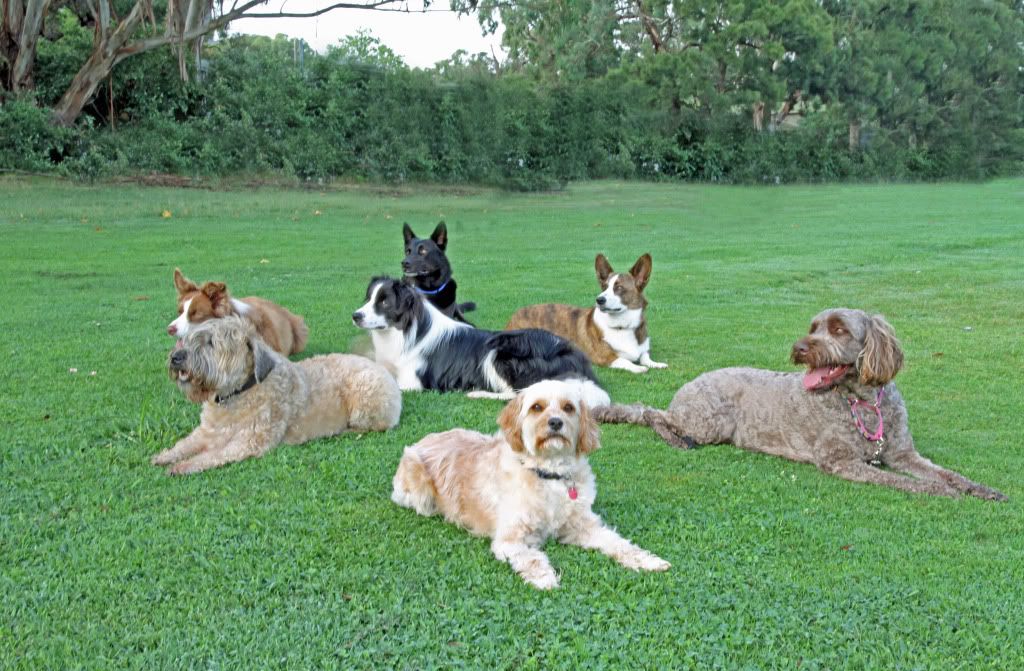
John has said that if we ever want any more photos taken, he would be happy to do so. He could take the shots more front on, with the dogs for example being in a semi circleetc. This way we might get a better view of all the dogs.

Best Clicker DVDs and Books?
Thanks for your time.
Training with Benefits
So thanks, folks, I've really enjoyed these sessions and your company, and I look forward to continuing to work around our other training obligations to get together at least semi-regularly. And big thanks to Ange for all her hard work in coordinating our sessions!
Thursday, February 3, 2011
Hitting the ground running
I'll need to nag about steering wheels and reins over the next few weeks though.
Blog Admin
Wednesday, February 2, 2011
Tully and fluffies
Desensitization & Counter Conditioning
I am interested in helping fearful and/or aggressive dogs and have been reading up on the difference between desensitisation and counter conditioning ( see below if you are unsure). I was interested to read some examples of how counter conditioning ( in particular aversive counter conditioning) is used with humans, thus have included an example at the end of this post!
Desensitization:
Desensitization is a process in which we reduce the strength of a response to a certain stimulus. For example, if your dog responds fearfully to the site of another dog, by desensitizing your dog to other dogs we will reduce the fearful response.
Desensitization works by gradually exposing the dog to low levels of the fearful stimulus.
In our example, we may let the dog see other dogs from a distance long enough so they do not show fear. Gradually, we will let the other dogs get closer and closer as long as the dog shows no fear.
Desensitization is usually accompanied by another process called counter conditioning.
Counter Conditioning:
Counter conditioning is really nothing more than classical conditioning. The big difference is that the dog already has an association between 2 events so changing this association and creating a new one requires a lot of repetitions.
Think of it this way. Let’s say Pavlov would have done the experiment a bit differently. Let’s say Pavlov would have started by associating the ring of a bell to a painful electric shock. The dog would have known that a bell ring means an electric shock and would have displayed fearful or aggressive behavior when the bell rang.
Now, after hundreds of repetitions and after this association is in place Pavlov would go ahead and start associating the same bell ring with food. Pavlov would have tried to counter condition the dog to the bell ring. It meant pain, and we want it to mean food from now on.
How long would it have taken to accomplish that? I can’t answer this specifically but it would have taken a long time and many repetitions.
Back to our example: we want to counter condition our fearful dog to accept other dogs. By combining counter conditioning and desensitization we can accomplish that. We will start exposing our dog to other dogs at a very low level – in this case a far enough distance (that’s the desensitization part). In addition, we will give the dog very tasty treats when he sees the other dogs (that’s the counter conditioning part). Gradually, we can convince the dog that other dogs mean good treats.
Human example!!
PS - Oops a bit long for a blog. I will keep the next one shorter!
YOUTUBE - TAB 289 & KIKOPUP
Tuesday, February 1, 2011
Dumbell Work - 1 min Youtube
I am just messing around with uploads - 1 minute of video takes an hour to upload - nearly 90mb! I've missed the bit with Rosie just looking past the dumbell (avoidance) then dropping it on my foot - ouch!
I think I'll bring the vid on Saturday so watch out!
Clicking to calm
I've suggested that she try something similar to what Ange suggested for Tully - set up a distance from where she knows other dogs will pass, and click and reward for calm behaviour, and focus on her instead of the other dog. Rewarding for the right sort of behaviours, and making other dogs approaching a positive experience again. It makes sense to her, which is a good start, so we'll see how it goes.
Anyone got any other suggestions?